
News & Insights
Claw Machine Payout Rate Settings: A Complete Tuning Guide for Arcade Operators (2026)
Coins per play, win frequency, strong and weak grip — how the four dials interact, the math that sets them, and how an in-house control board keeps payout behaviour consistent.
QUICK ANSWER: Four settings decide everything: coins per play, payout frequency (one prize every N plays), strong grip strength, and weak grip strength. Set them from two numbers — your prize cost and your revenue per play — not from gut feeling. A $1.50 plush at two coins per play needs roughly one prize every 5 to 8 plays to keep a healthy margin. This guide walks through what each dial does, the math that sets it, and how to tune without breaking your floor.
If you run a claw machine or a bank of them, you already know the feeling: a machine can be set so tight that players walk away after three tries, or so loose that the prize cabinet empties by Saturday. The difference between those two machines is four numbers in a settings menu — and most operators never learn what they actually do.
This guide is for arcade owners, FEC operators and claw machine shop owners who want to tune payout rate with a method instead of a guess. It covers the settings themselves, the math behind them, a tuning workflow you can run on a live floor, and the hardware side — because how consistently a board holds its settings matters as much as the settings themselves.
Payout Rate Is a Ratio, Not a Feeling
"Payout rate" sounds like a percentage, but in claw machines it is almost always expressed as a ratio: one prize every N plays. Set it to 1 in 15, and the machine is designed to deliver a strong grip on roughly every fifteenth play.
That number is not just about player experience. It is the core of your unit economics:
Revenue per play = coins per play × value of one coin.
Cost per prize = what the plush actually costs you.
Target plays per win = (prize cost + profit you want per win) ÷ revenue per play.
Run it with real numbers. If one coin is worth US$0.222 (the equivalent of US$10 for 45 coins), two coins per play means US$0.444 of revenue per play. A US$1.50 plush needs at least 3.4 plays just to break even on that prize. Every play after that is margin.
This is why nobody can give you "the right payout rate" from a blog post. The right number depends on your coin value, your prize cost and your rent. The formula is the only portable part.
The Four Dials Inside the Menu
A commercial claw machine's settings menu looks intimidating the first time. In practice, four parameters do almost all the work — plus a few secondary settings that shape the feel.
1. Coins per play. The price of one attempt, usually 1 to 5 coins. This is your revenue dial: raising it raises revenue per play, but only if players accept the price.
2. Payout frequency (win cycle). One prize every N plays. This is the dial most operators mean when they say "payout rate." It controls the long-run ratio, not each individual attempt.
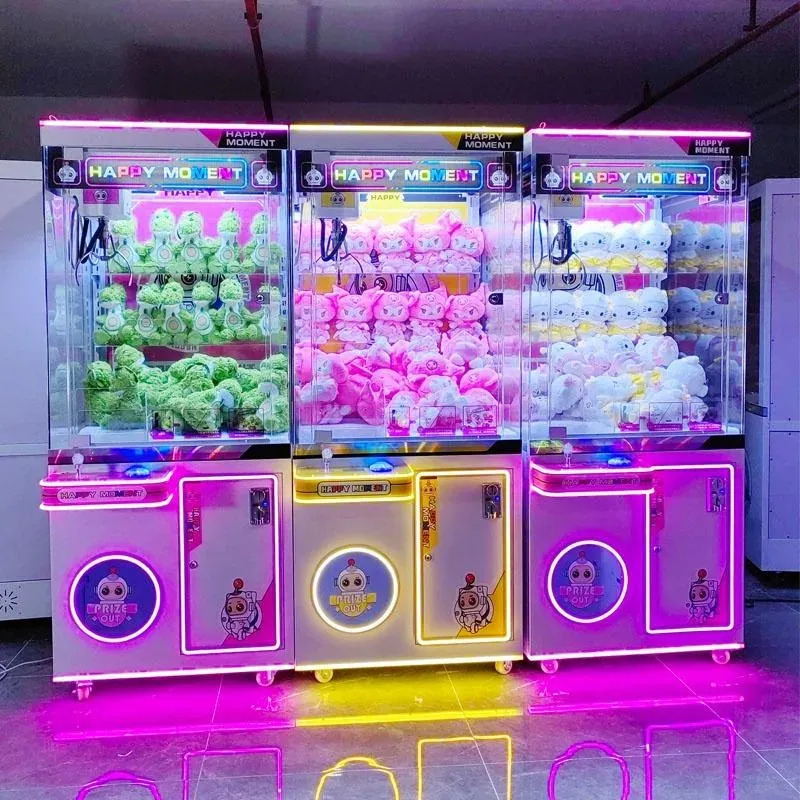
3. Strong grip strength. The grip power used on a winning attempt — the setting that decides whether the claw actually holds the prize all the way to the chute.
4. Weak grip strength. The grip power used on non-winning attempts. This creates the near-miss: the claw lifts, the prize slips, the player sees how close it was.
Two secondary settings complete the picture:
Hold (top) strength. The grip maintained while the claw travels to the prize chute. A weak hold after a strong lift is one of the most common causes of "it grabbed it and dropped it" complaints.
Release point. Where the claw opens on a non-winning attempt. Moving the release point closer to the chute makes near-misses feel more painful — and more motivating.
Strong Grip, Weak Grip, and the Near-Miss
The psychology of a claw machine is not complicated, and it is not a trick: players need to see the machine almost give them a prize. That is what a weak-grip setting creates — a lift, a slip, an "I almost had it."
Two effects make this work:
The near-miss effect. A near miss is more motivating than no attempt at all. When the prize slips right at the chute, the player has evidence that the machine can pay — so the next coin feels like a reasonable bet.
The winner effect. One visible win changes the mood of the whole floor. Players who watch someone else win are more likely to play, and the person who won is more likely to play again. This is why prize cabinets should be visible from the aisle, not hidden behind a pillar.
The mistake is to treat weak grip as "the tight setting." It is not: weak grip is the setting that makes the machine feel winnable without paying too often. Tune it too tight and the claw looks broken; tune it too loose and every attempt feels like a win, which destroys the tension that makes the game fun.
The Math, With Real Opening Settings
Here is the same math with the settings a real customer store used on opening week. Clawtopia — a claw machine chain in the United States, store at 8023 W Broad St, Henrico, Virginia 23294 — opened with:
- US$10 for 45 coins
- 2 coins per play
- A prize roughly every 5 to 8 plays
- Plush prizes around US$1.50 each
Run the numbers:
Plays per US$10: 45 ÷ 2 = 22.5 plays.
Wins per US$10: 22.5 ÷ 8 to 22.5 ÷ 5 = 2.8 to 4.5 prizes.
Prize cost per US$10: 2.8 × $1.50 to 4.5 × $1.50 = US$4.20 to US$6.75.
Gross profit per US$10: US$3.25 to US$5.80 — a gross margin of roughly 32% to 58%.
That is a deliberately generous opening-week setting. The store was buying something other than margin: first impressions, repeat visits and word of mouth. And even so, it kept a third to more than half of every dollar played.
Now scale it to a day. At 50 plays per day per machine, that is US$7 to US$13 of gross profit — which pays back a US$400 to US$550 machine in roughly one to two and a half months.
Inside Our Own Control Board
Here is the part most claw machine buyers never see: the board that runs the machine.
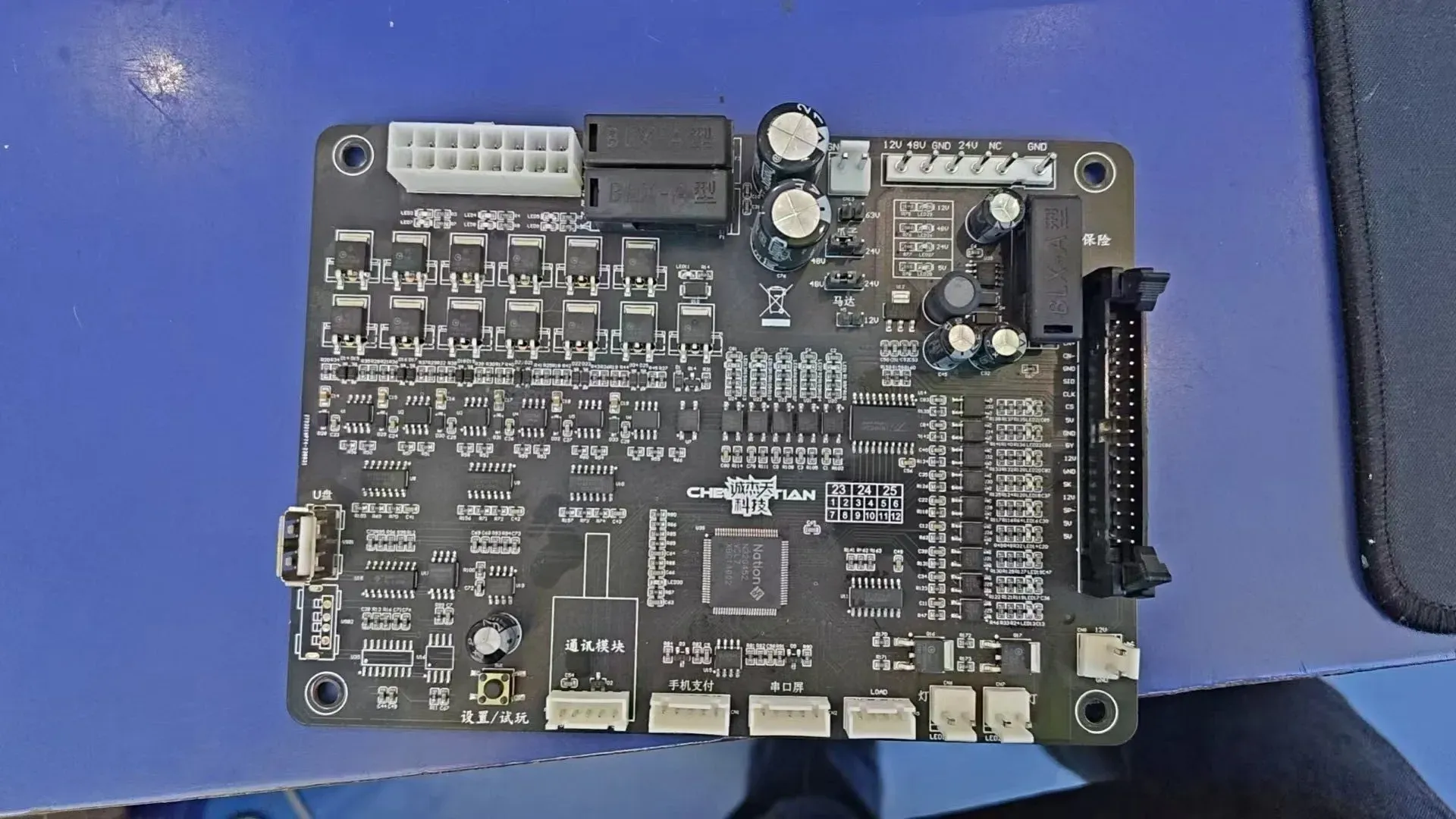
Many claw machines in the market run on a control board sourced from a third-party supplier. Ours is developed in-house at our own factory — and that matters in six practical ways:
Stable multi-voltage power. The board carries 12V, 24V and 48V outputs on one platform. Different mechanisms — crane motors, coin acceptors, lighting, the screen — need different voltages, and delivering them from one designed board means fewer adapters, fewer failure points and more consistent claw behaviour across a batch.
RS232 communication with a dedicated module port. The board communicates over RS232 and has a separate connector for its communication module. That is the physical path for features that depend on connectivity — starting with phone-based parameter management, so an operator can change settings on a machine from a smartphone instead of opening the cabinet.
Mobile payment and serial-screen interfaces. The board exposes a dedicated mobile payment connector and a serial screen port, so the settings menu and payment options can be upgraded without replacing the whole control system.
A digital tube counter. The board carries a digital tube counter that shows play and coin counts at the cabinet — useful for staff doing daily reconciliation without logging into anything.
An on-board settings/test button. There is a physical settings / test-play button on the board itself. A technician can run a test play and reach the settings without digging through menus — which matters when you are tuning twenty machines, not one.
Protection built in. The board carries an on-board fuse rated for the platform's load, so a wiring fault does not take out the whole cabinet.
And the part that ties back to this article: payout behaviour is firmware, not luck. Because the board and its firmware are ours, the win cycle, claw strength values and award mode behave consistently across every machine in a batch — and when a board needs service, the replacement comes from the same source as the original.
What the Settings Menu Actually Looks Like
The firmware on this board opens on four top-level menus:
1. Gameplay — the play mode for the cabinet.
2. Catch set — claw behaviour: strength and catch parameters.
3. Game set — the money and payout logic.
4. Motor speed — how fast the crane travels.
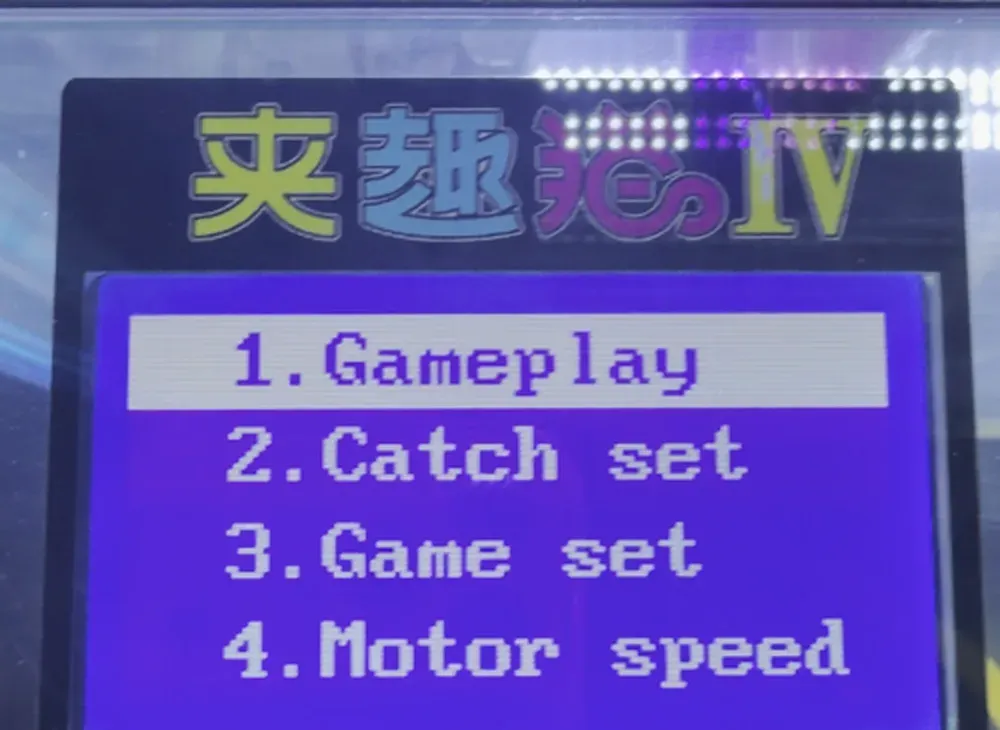
Two things in that menu matter more than the rest.
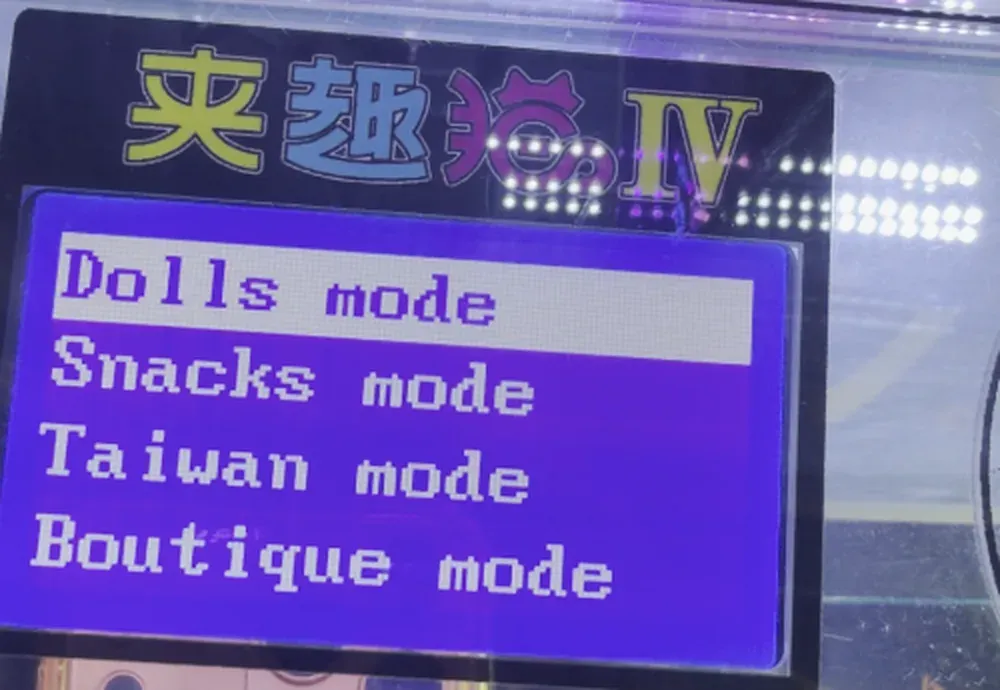
The Gameplay menu carries preset modes, not just one generic behaviour: Dolls mode, Snacks mode, Taiwan mode and Boutique mode. Each mode suits a different prize type and play feel — a snack cabinet and a boutique cabinet should not feel the same to the player, and a preset gets you to a sensible starting point in seconds instead of trial and error.
The Game set screen is where the payout rate lives. It shows four values:
- Game Ratio — the play counter for the cycle.
- Coin Ratio — coins required per play.
- Probably — the win cycle: one prize every N plays. In the screen below it reads 15, meaning a strong grip lands roughly every fifteenth play.
- Award Mode — set to Fixed, so the cycle is predictable rather than random.
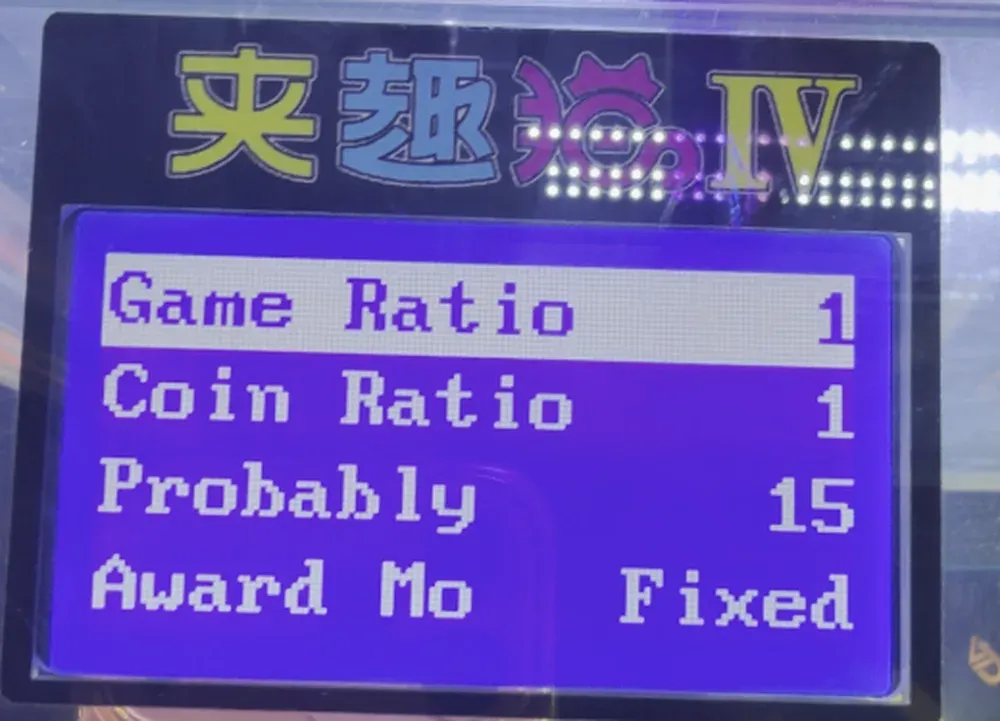
That screen is the whole article in four values: set Coin Ratio to the price your players accept, set Probably to what your prize cost allows, keep Game Ratio at 1 unless you are stacking plays per cycle, and leave Award Mode on a setting your staff can explain to a customer.
Tuning by Prize Type
The right payout frequency is a function of prize value. As a reference framework:
Small prizes (candy, keychains, mini plush under US$1). Short cycles — a prize every 3 to 5 plays — keep the game fast and the fun frequent.
Standard plush (roughly US$1 to US$4). A prize every 5 to 20 plays, depending on your coin value and rent. Clawtopia's opening setting of 1 in 5 to 8 with a US$1.50 prize sits at the generous end of this band.
High-value prizes (US$20 and up). These do not fit the same math at a low coin value. At US$0.44 revenue per play, a US$25 prize needs about 56 plays just to break even — so a premium prize needs either a higher price per play or a different cabinet that is built for it. In practice, operators running premium prizes fill the cabinet with authentic blind boxes and collectible figures — licensed blind-box series, Labubu and similar trend-driven characters — where the prize itself is the draw. Those prizes justify a higher coin price and a longer cycle, because the player is not buying a plush: they are chasing a specific character.
A Tuning Workflow That Doesn't Break Your Floor
Tuning live machines is risky if you change everything at once. Use a sequence:
1. Set a baseline and leave it alone for a week. Record coins per play, win cycle, prize cost and the machine's daily play count.
2. Change one dial at a time. If you change the win cycle and the grip strength together, you will never know which change moved the numbers.
3. Use a control machine. On a bank of machines, tune one at a time and keep the others at baseline. Compare plays per day and prize draw between the tuned machine and the control.
4. Watch two numbers, not one. Prize stock draw tells you the payout side; plays per day tell you the demand side. A setting that protects margin but kills plays is not a win.
5. Document the setting. Write down the exact values you shipped with. When a machine is serviced or a board is replaced, you need to restore the same configuration — and that is much easier when the board and firmware are consistent across the batch.
Opening Week: Start Generous, Tighten Slowly
Clawtopia's opening settings — US$10 for 45 coins, 2 coins per play, a prize every 5 to 8 plays — were chosen on purpose. Opening week is when a venue builds its reputation, and a generous machine creates winners, spectators and word of mouth.
The mistake is to leave opening settings running forever, or to tighten them abruptly the moment the first month ends. Tighten in small steps — one dial at a time, with a week of observation between changes — and watch plays per day as carefully as you watch prize draw. If plays fall faster than prize cost, you have tightened too far.
When Players Complain or Prizes Vanish: Symptom → Setting
Most claw machine complaints map to one specific setting:
"The claw grabs it and drops it." Check hold (top) strength first, then the release point — not the payout cycle.
"It never grabs anything." Weak grip may be too low, or the prize may be too heavy or too large for the claw opening. Check the prize first, then the grip.
"Players win too often and the cabinet empties." Lengthen the win cycle or lower the weak-grip value — one change at a time.
"Nobody plays after the first week." The cycle is probably too tight. Add near-miss (weak grip) and shorten the cycle slightly.
"Two machines with the same settings behave differently." This is usually a hardware or firmware consistency issue — mixed boards, different firmware versions or worn mechanisms. Matching boards and firmware across a batch removes the variable.
What In-House Hardware Means After the Sale
A control board is a part that wears, gets damaged by power surges, or gets replaced when a machine moves. When the board is in-house:
Spare boards come from the same source. No chasing a discontinued third-party board or a firmware version nobody stocks.
Settings are reproducible. The same board family and firmware means the same settings behaviour across your floor.
Service is direct. Our machines ship with a one-year warranty and lifetime free maintenance, and each order includes a complimentary spare-parts package — so a board or claw issue does not become a months-long wait.
Your Next Step
Send us your machine model, your prize cost and your coin value, and we will reply with a recommended starting configuration for your floor — plus the settings sheet we use when we preset machines before shipping.
A payout rate is a decision, not a default.